Google’s New Transparency Warnings: Dealing with 'Review Manipulation' Flags
If you’ve logged into your Google Business Profile recently, you might have noticed a subtle but significant change in the atmosphere. Google has always been the "sheriff" of local search, but as of May 2026, it has officially pinned on a much bigger badge.
For years, some businesses have played a dangerous game: flagging every negative review as "spam" or pressuring customers to delete their 1-star complaints. It was a "whack-a-mole" strategy that worked just well enough to keep a 4.9-star average. But those days are over.
Google’s new Transparency Warnings are now live. If Google’s algorithm suspects you are manipulating your reviews: particularly by deleting negative ones: it doesn't just hide your profile; it slaps a public warning on it for every potential customer to see.
It’s the digital equivalent of a "Health Inspector" notice in a restaurant window. Here’s why it’s happening, how the tech actually works, and how you can ensure your business stays on the right side of the law.
The Era of 'Radical Transparency'
Google’s goal has shifted. In the past, they focused on quantity and quality of reviews. Now, they are obsessed with authenticity. They’ve realised that a perfectly clean 5.0-star rating with zero negative feedback is often less trustworthy than a 4.5-star rating with a few handled complaints.
The "Transparency Warning" is a public label that appears at the top of a business profile. It essentially tells searchers: "We’ve detected unusual activity here. Some reviews may have been removed or manipulated." For a local business, this is a death sentence for conversion. Who would book a dental appointment or hire a builder with a "manipulation" warning hanging over their head?
The Anatomy of an Anomaly: How the ML Catches You

You might think, "How does Google actually know I’m deleting reviews?" They aren't just looking at your dashboard; they are using sophisticated Machine Learning (ML) based anomaly detection.
Think of your business’s review history like a heartbeat. A healthy business has a steady, rhythmic "pulse" of feedback. Maybe you get three reviews a week, mostly 4 and 5 stars, with the occasional 2-star moan about the parking.
When you start manipulating reviews, that pulse becomes irregular. Google’s ML models are trained on billions of reviews across millions of businesses. They know exactly what "normal" looks like for a plumber in Reading or a cafe in Manchester.
The algorithm flags "spikes" that don't make sense: * The Positive Surge: If you suddenly get 40 five-star reviews in 48 hours after six months of silence, the system marks it as an anomaly. * The Textual Fingerprint: ML can now spot "Review Farm" patterns: generic phrases like "Great service, highly recommend" repeated by accounts that have never been near your postcode. * The Location Disconnect: If your reviews are coming from IP addresses in another country, but you're a local carpet cleaner, the "Information Gain" score drops to zero, and the red flags go up.
The 'Bayesian' Brain: Why Google is Smarter Than Your Spreadsheet
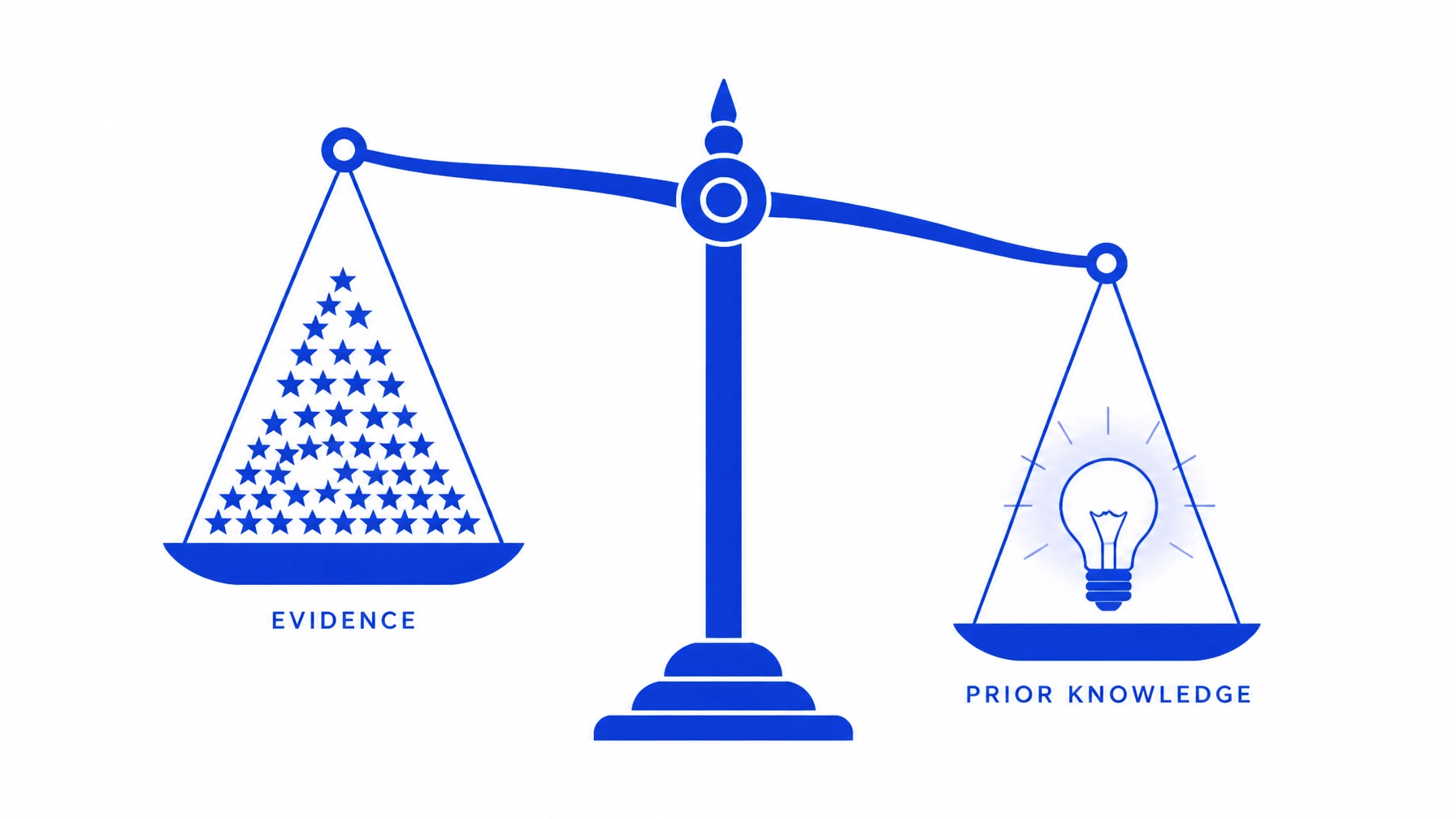
To get even more technical, Google is using Bayesian reasoning to judge your credibility. In simple terms, Bayesian logic is about updating the probability of a "truth" based on new evidence.
Google starts with a "Prior": a belief based on your history. If you've been a 3.8-star business for three years, that is the "prior probability" of your service level. If, suddenly, your rating jumps to 4.9 without any change in your foot traffic or search volume, the Bayesian model asks: "What is the probability that this business actually got 50% better overnight versus the probability that they are cheating?"
When the "New Evidence" (the sudden 5-star reviews) contradicts the "Prior" (your 3-year history) too sharply, the probability of manipulation shoots up. Google doesn't need "proof" in the legal sense; they just need the mathematical probability of honesty to drop below a certain threshold. Once it does, the Transparency Warning is triggered.
The Deletion Trap: Why Hiding Your Mistakes Is Now Your Biggest Mistake
This is the part of the 2026 update that is catching most business owners off guard. Google is now tracking deletion patterns.
Every time you flag a review to be removed, or every time a customer deletes a review after you've had a "chat" with them, Google takes a note. If the statistical distribution of your deleted reviews is heavily skewed toward 1 and 2 stars, you are in trouble.
In a natural world, people delete reviews for all sorts of reasons: they made a mistake, they went to the wrong shop, or they changed their mind. In that natural world, a mix of positive and negative reviews get deleted.
However, if 95% of the reviews deleted from your profile are negative, Google’s Bayesian model concludes that you are "Gating" or "Cleaning" your profile. By trying to look perfect, you are actually proving to the algorithm that you are untrustworthy.
At YourReviews, we always tell our clients: Don't fear the 1-star review. A negative review is an opportunity to show off your customer service. When you use an automated review management tool, you can respond to those negatives instantly with AI-generated, professional replies that de-escalate the situation before it becomes a "deletion" problem.
The Penalty: What Happens When You Get Flagged?
The public warning is just the tip of the iceberg. Behind the scenes, the consequences are severe:
- Local Pack Demotion: You will likely vanish from the "Top 3" map results. Google won't promote a business it has publicly flagged as manipulative.
- Review Shadow-Banning: Future honest reviews from real customers may be filtered out and never see the light of day because your profile is "under investigation."
- Loss of Trust: Even if the warning is eventually removed, the damage to your brand is done. Customers have long memories.
The Path Forward: How to Manage Reviews the Right Way
So, how do you avoid the dreaded Transparency Warning while still maintaining a great rating? The answer is consistent, organic volume.
Google loves "velocity": a steady stream of fresh reviews. Instead of trying to "fix" your score by deleting the bad stuff, you should be focused on drowning out the occasional negative with a flood of new, genuine positives.
Here is the 2026 playbook for local businesses:
- Automate the Request: Don't wait until you're "feeling lucky" to ask for a review. Set up an automated system that sends an SMS or WhatsApp request to every customer. This ensures your review pattern matches your actual business activity.
- Respond Authentically: Use AI to help you draft responses, but make sure they address the customer's specific points. An AI-powered response that acknowledges a mistake and offers a solution is worth ten "deleted" reviews in the eyes of both Google and your customers.
- Embrace the 4.5: Aim for excellence, not perfection. A 4.5-star rating with 500 reviews looks significantly more "real" to Google’s Bayesian brain than a 5.0 with 50 reviews.
- Use the Right Tools: Use a platform like YourReviews to monitor your sentiment in real-time. If the ML starts to see a dip in your service quality, you can fix the business problem before it becomes a "reputation" problem.
The "Transparency Warning" update is Google’s way of saying that the era of shortcut SEO is over. You can’t "optimise" your way out of a bad reputation anymore. The only way to win in 2026 is to be consistently good and consistently honest.
Stop trying to hide the negatives. Start automating the positives. Your ranking: and your conscience( will thank you for it.)